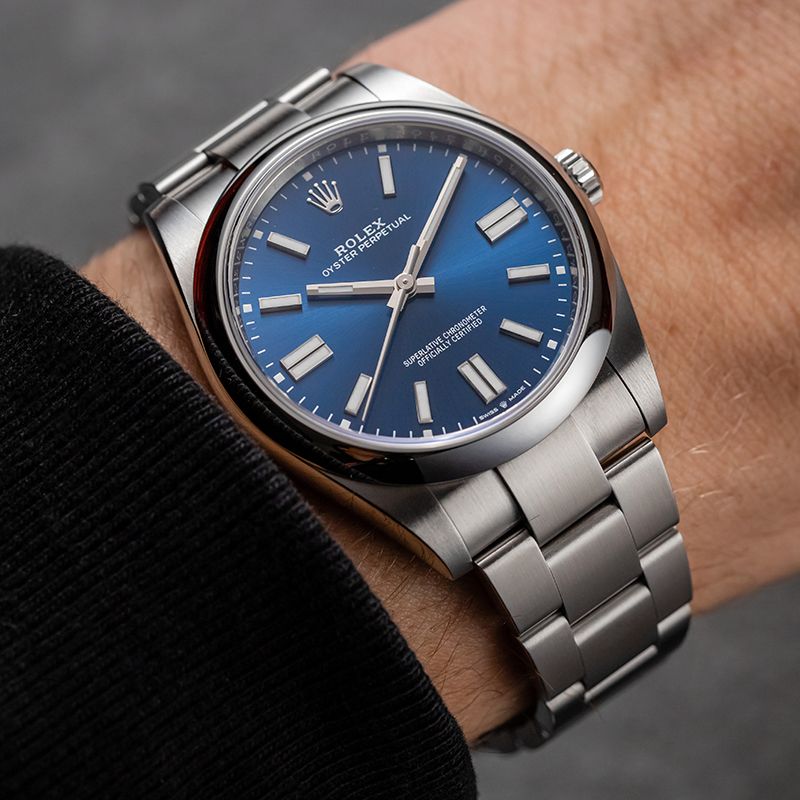
The Rolex Oyster Perpetual: A Reflection on Tradition and Change
Rolex describes the Oyster Perpetual as the “Oyster in its purest form.” It embodies simplicity—no date, no rotating bezel—just the iconic water-resistant case that helped propel Rolex into success throughout the 20th century. In the late 1920s, Rolex revolutionized watchmaking by incorporating a rubber gasket and a precision screw thread, making the watch highly resistant to water. Back then, it must have seemed remarkable—a watch that looked ordinary but could withstand conditions other watches wouldn’t survive.
Rolex didn’t just allow the Oyster to get wet—they intentionally submerged it, pushing the boundaries of performance. By the early 1930s, rumors suggested that 74% of Oyster watches were found underwater, proof of their endurance. To this day, many of these watches remain lost beneath the waves, a testament to the robustness of Rolex’s design.
If there ever was a distillation of what a watch should be, it’s the Oyster. Features like the self-changing date are useful, but not essential to its core function. For Mercedes Gleitze, who famously swam across the freezing English Channel wearing a Rolex Oyster, knowing the exact date wasn’t as crucial as the certainty that her watch would work when she needed it most.
In an ideal world, I’d love for the Oyster Perpetual to be a manual-wind watch, but I recognize that most Rolex buyers prefer the convenience of an automatic. That’s why the Oyster Perpetual remains as it is: simple, elegant, and automatic, with minimal text on the dial—a refreshing contrast to the increasingly verbose designs on many of Rolex’s newer models. And for a while, you could get this pure expression of Rolex at 39mm, which, for me, was the perfect size.
Rolex’s origins go back to 1905, when the company was founded as Wilsdorf and Davis by Hans Wilsdorf and Alfred Davis. By 1915, it had become the Rolex Watch Co. Ltd., establishing itself as one of the world’s leading luxury watch brands.
In my opinion, 39mm is the ideal size for a watch. It’s not a universally acknowledged fact, but rather something that feels inherently right—like hearing a song that resonates deeply with you. Wearing a 39mm watch just feels balanced, offering a harmonious blend of presence and subtlety. But Rolex had other ideas, and they discontinued the 39mm version, leaving us with two choices: 36mm or 41mm.
The 41mm Oyster Perpetual feels slightly off. While larger case sizes have become more popular, particularly with models like the Sea-Dweller and Submariner, I can’t help but feel like Rolex missed the mark with the 41mm Oyster Perpetual. It’s like putting a moustache on a donkey—it might seem interesting in theory, but it doesn’t quite work. Donkeys have survived perfectly well without them, and the same could be said for the Oyster Perpetual without the increase in size.
However, Rolex didn’t make this decision without reason. The trend towards larger watches is undeniable, and the 39mm version wasn’t universally loved. Many people found it too small, and while I may prefer the smaller size, I can understand why Rolex decided to cater to a broader audience by increasing the dimensions.
I’m not in charge of Rolex, nor should I be, and my opinion likely means little in the grand scheme of things. I’ve never bought an Oyster Perpetual because I believe I can get better value elsewhere. That being said, I’m not a typical Rolex customer, and Rolex is catering to a demographic that knows what it wants. My personal preferences aside, Rolex understands its market, and their decision to introduce a 41mm model is based on careful consideration.
It’s easy to criticize from the sidelines. We tend to form opinions based on our own limited experiences, often overlooking the broader picture. Rolex, on the other hand, has access to extensive data and market trends, which guide its decisions. Just as people once criticized Porsche for introducing the Cayenne SUV, only to see it become one of the brand’s best-selling models, Rolex’s decision to increase the size of the Oyster Perpetual likely has sound reasoning behind it.
At the end of the day, this isn’t really a review of the watch itself. Yes, it’s slightly bigger and features the new 3230 movement, which offers marginal improvements. But for me, this watch represents a moment of introspection—a realization that, while the market may be shifting, my preferences remain rooted in a different era.
Ultimately, it’s not about what I think, but about your own judgment. Should you buy the 41mm Oyster Perpetual or not? The decision is yours to make. If you’re still interested, you can find a Rolex Oyster Perpetual (or its replicas) listed on DHgate from the seller supermarket_watches here.